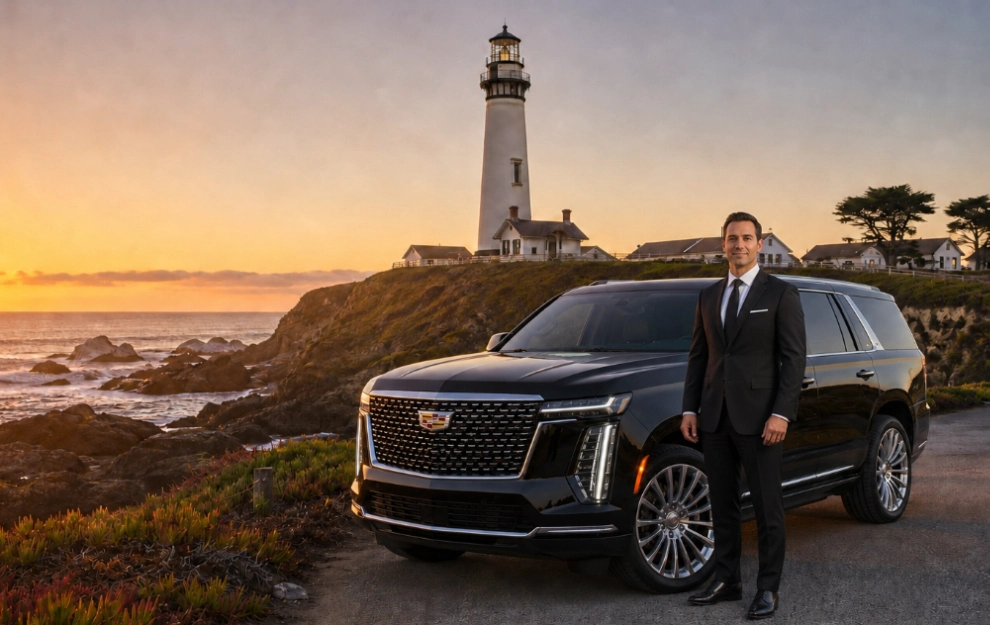
The drive from Carmel-by-the-Sea to Los Angeles along Highway 1 is one of the most celebrated road trips in the United States. The typical route follows the Pacific Coast Highway south from Carmel through Big Sur, over the iconic Bixby Creek Bridge, through San Luis Obispo, past Pismo Beach and the Santa Ynez Valley, through Santa Barbara, along the Malibu coastline, and into Los Angeles. The full coastal distance runs approximately 350 miles, with a drive time of ten to twelve hours without stops. Most travelers cover it over two days with an overnight in Cambria or San Luis Obispo at the midpoint.
A private chauffeured transfer with 5 STARS Limousine Connection transforms this route from a driving obligation into the experience it is designed to be. Your chauffeur handles every mile of the route while your group takes in the coastline, stops when the view demands it, and sits down to a proper lunch at the right spot rather than eating in the car. This guide covers the full route, the best stops along the way, dining recommendations at each segment, and what to confirm when booking a private coastal transfer.
Why a private transfer makes this drive different
The Big Sur section of Highway 1 between Carmel and Cambria is narrow, two-lane, and demands full driver attention. Averaging 35 miles per hour through the most scenic sections is realistic, and pulling in and out of coastal viewpoints while managing a vehicle adds significant cognitive load to what should be a relaxing experience. When you are a passenger rather than a driver, the clifftop views, the morning fog lifting off the Pacific, and the drama of Bixby Bridge become the entire experience rather than a distraction from the road.
A chauffeured coastal transfer also accommodates a flexibility that a rental car arrangement cannot. Your itinerary can shift in real time. If a viewpoint calls for thirty more minutes, you stay. If the lunch reservation in Cambria looks better than the one you originally planned, the chauffeur adjusts the timing. The rate is confirmed at booking and does not change based on how the day unfolds.
The route and recommended stops
Carmel-by-the-Sea and Point Lobos
The drive south from Carmel begins with Carmel Beach, one of the most photographed stretches of coastline on the Peninsula, before reaching Point Lobos State Natural Reserve just minutes south of the village. Point Lobos is one of the finest coastal parks in California, offering tide pools, dramatic cliffs, and one of the best accessible viewpoints of the Big Sur coast before it begins in earnest. Allow an hour here if the itinerary permits.
Big Sur
The Big Sur Coast Highway runs 71 miles from Malpaso Creek near Carmel Highlands to San Carpoforo Creek in San Luis Obispo County, and as of January 2026 the full route is open. The corridor encompasses some of the most dramatic coastal scenery in the world: vertical cliffs dropping directly into the Pacific, redwood groves tucked into inland canyons, and a sequence of bridges and viewpoints that reward an unhurried pace.
Bixby Bridge, approximately thirteen miles south of Carmel, is one of the most photographed bridges in California and a mandatory stop. The viewpoint above the bridge on the northern approach provides the classic angle. Big Sur Village, roughly one hour south of Carmel, is the commercial center of the corridor and a natural stopping point for coffee, a walk into the redwoods at Pfeiffer Big Sur State Park, or a seat at one of the coast's most distinctive restaurants.

Where to eat in Big Sur: Nepenthe is the essential Big Sur dining experience: an open-air terrace cantilevered over the cliffs with sweeping ocean views, serving California-influenced dishes in a setting that has drawn writers, artists, and travelers since the 1940s. Reservations are strongly recommended. Sierra Mar at Post Ranch Inn offers a more formal tasting menu experience with a glass dining room on the cliff and one of the most extensive wine lists in the region. Lunch and dinner reservations are required and should be made well in advance.
Ragged Point and San Simeon
Ragged Point sits at the southern end of the Big Sur coast, approximately two hours south of Carmel, and marks the transition from the most dramatic section of the drive to the broader coastal landscape of San Luis Obispo County. The Ragged Point Inn provides a natural overnight option for travelers breaking the trip into two days, with cliff-edge views and a dining room facing the Pacific.
Hearst Castle in San Simeon sits just beyond Ragged Point and is one of the most visited landmarks on the California coast. The estate built by William Randolph Hearst atop a hill above San Simeon Bay offers guided tours of the main house, the Neptune Pool, and the grounds. Reservations are required and sell out well in advance during peak season. A stop here adds one to two hours to the day's itinerary depending on the tour selected.
Cambria and Cayucos
Cambria is a charming seaside village with a compact main street, antique stores, art galleries, and Moonstone Beach, a driftwood-strewn stretch of coastline with a boardwalk suitable for an afternoon walk. It sits approximately 57 miles south of Ragged Point and serves as the natural midpoint for a two-day coastal transfer.
Where to eat in Cambria: Sea Chest Oyster Bar on Moonstone Beach Drive is a Cambria institution, serving fresh seafood in a no-reservations dining room that fills quickly on weekend evenings. Arrive early. Madeline's on Main Street offers French-influenced California cuisine in a more formal setting and takes reservations.
Cayucos, just south of Cambria, is a quieter fishing village with a historic pier, a handful of good restaurants, and a slower pace than the more tourist-trafficked towns to the north and south.
Morro Bay and San Luis Obispo
Morro Bay's harbor is defined by the 576-foot volcanic rock at its entrance, Morro Rock, and the sea otters that have established a nursery colony in the protected harbor waters. The Embarcadero along the waterfront offers fresh seafood directly off the boats and a straightforward view of one of the coast's most distinctive landmarks.
San Luis Obispo has grown from a mission town into one of California's better dining cities, with a farm-to-fork food scene and a wine industry drawing from the nearby Edna Valley and Arroyo Grande appellations. The Thursday Farmers Market on Higuera Street is a regional institution when the timing aligns. SLO is also where Highway 1 merges with US-101 southbound, and the inland route through the Santa Ynez Valley becomes available as an alternative to continuing on the coast.
Pismo Beach and the Santa Ynez Valley
Pismo Beach offers broad sandy beaches, a classic California pier, and a relaxed coastal town atmosphere that suits a late-afternoon stretch between Morro Bay and Santa Barbara. From Pismo, the route south follows US-101 through the Santa Ynez Valley wine country, passing through Los Alamos, Los Olivos, and Solvang before approaching Santa Barbara from the north.

The Santa Ynez Valley detour adds an hour to the drive but delivers wine country dining and a landscape that contrasts sharply with the coast. Los Olivos has a concentration of tasting rooms and good restaurants around its village center and is worth a stop if the timing allows.
Santa Barbara
Santa Barbara sits approximately two hours north of Los Angeles on US-101 and marks the final major stop before the approach into Southern California. State Street in downtown Santa Barbara, the Santa Barbara Mission, and the waterfront at Stearns Wharf are the central points of interest. For a dinner stop before the final leg into Los Angeles, the lower State Street restaurant corridor offers a range of options from casual seafood to formal California cuisine.
Malibu and the approach into Los Angeles
South of Ventura, the route transitions from US-101 back to Highway 1, running through Malibu along the Pacific Coast Highway before arriving in Santa Monica and Los Angeles proper. The Malibu stretch is best in the morning or late afternoon when the light falls across the coastline at an angle. Carbon Beach, Zuma Beach, and the Malibu Pier are the primary stopping points before the road delivers you into the city.
Two-day vs one-day itinerary
The full coastal route from Carmel to Los Angeles is not a one-day drive if you intend to experience what the route has to offer. Attempting it in a single day without stops takes ten to twelve hours and leaves most of the coastline in your rearview mirror. The recommended approach is a two-day itinerary with an overnight at Cambria, San Luis Obispo, or Pismo Beach.
Two-day Carmel to Los Angeles itinerary via Highway 1
| Day |
Segment |
Distance |
Key Stops |
| Day 1 |
Carmel to Cambria |
Approximately 120 miles |
Point Lobos, Bixby Bridge, Big Sur, Nepenthe, Ragged Point, Hearst Castle |
| Day 2 |
Cambria to Los Angeles |
Approximately 230 miles |
Moonstone Beach, Morro Bay, San Luis Obispo, Pismo Beach, Santa Ynez, Santa Barbara, Malibu |
For travelers on a tighter timeline, a single long day departure from Carmel at 7:00 AM with a midday stop in Cambria and an early evening arrival in Santa Barbara before a final push into Los Angeles is achievable. Your chauffeur manages the timing across the full route and adjusts stops based on how the day develops.
Vehicle options for the coastal transfer
A multi-hour, multi-day coastal transfer has specific vehicle requirements. Comfort over long distances matters. Cargo space for overnight bags matters. A cabin that allows the group to rest or take in the scenery without managing the drive matters.
- Executive SUV (up to 5 to 6 passengers): The best all-round option for most coastal transfer groups. Comfortable over long distances, enough cargo space for overnight bags, and a vehicle that handles the two-lane sections of Highway 1 without difficulty.
- Executive Sedan (up to 3 passengers): For couples and solo travelers who want a composed, quiet transfer with a focus on the route rather than group conversation.
- Executive XL Van (up to 13 passengers): For larger groups traveling together on the coastal route. Keeps the full group in one vehicle across a two-day itinerary without the coordination overhead of multiple cars at each stop.
Airport connections for the Los Angeles arrival
For travelers who begin the trip in Carmel or Monterey and need a connection to a Los Angeles airport at the end of the route, 5 STARS coordinates the final transfer to whichever terminal is required.
- Los Angeles International Airport (LAX): The primary international gateway, reached via I-405 or Lincoln Boulevard from Santa Monica.
- Burbank Bob Hope Airport (BUR): The most convenient airport for travelers connecting to the San Fernando Valley and eastern Los Angeles, approximately 45 minutes from Santa Monica under normal conditions.
- Long Beach Airport (LGB) and Orange County (SNA): For travelers continuing south toward Orange County or San Diego, these airports offer a shorter final drive from the coastal arrival point.
The return transfer from Los Angeles to Carmel or Monterey follows the same route in reverse or takes the faster US-101 inland approach depending on the traveler's preference and schedule.
How to book your coastal transfer
When requesting a quote for a Carmel or Monterey to Los Angeles transfer via Highway 1, provide the following:
- Departure address in Carmel or Monterey and departure time
- Final destination in Los Angeles or airport terminal
- Whether the transfer is one day or two days with an overnight
- Passenger count and luggage details including overnight bags
- Preferred stops and any restaurant reservations already confirmed along the route
All rates are confirmed at booking. For multi-day transfers, the full itinerary including overnight arrangements and return timing can be coordinated with the reservations team. Visit 5starslimo.com to request a quote or contact the team directly for complex itineraries.